
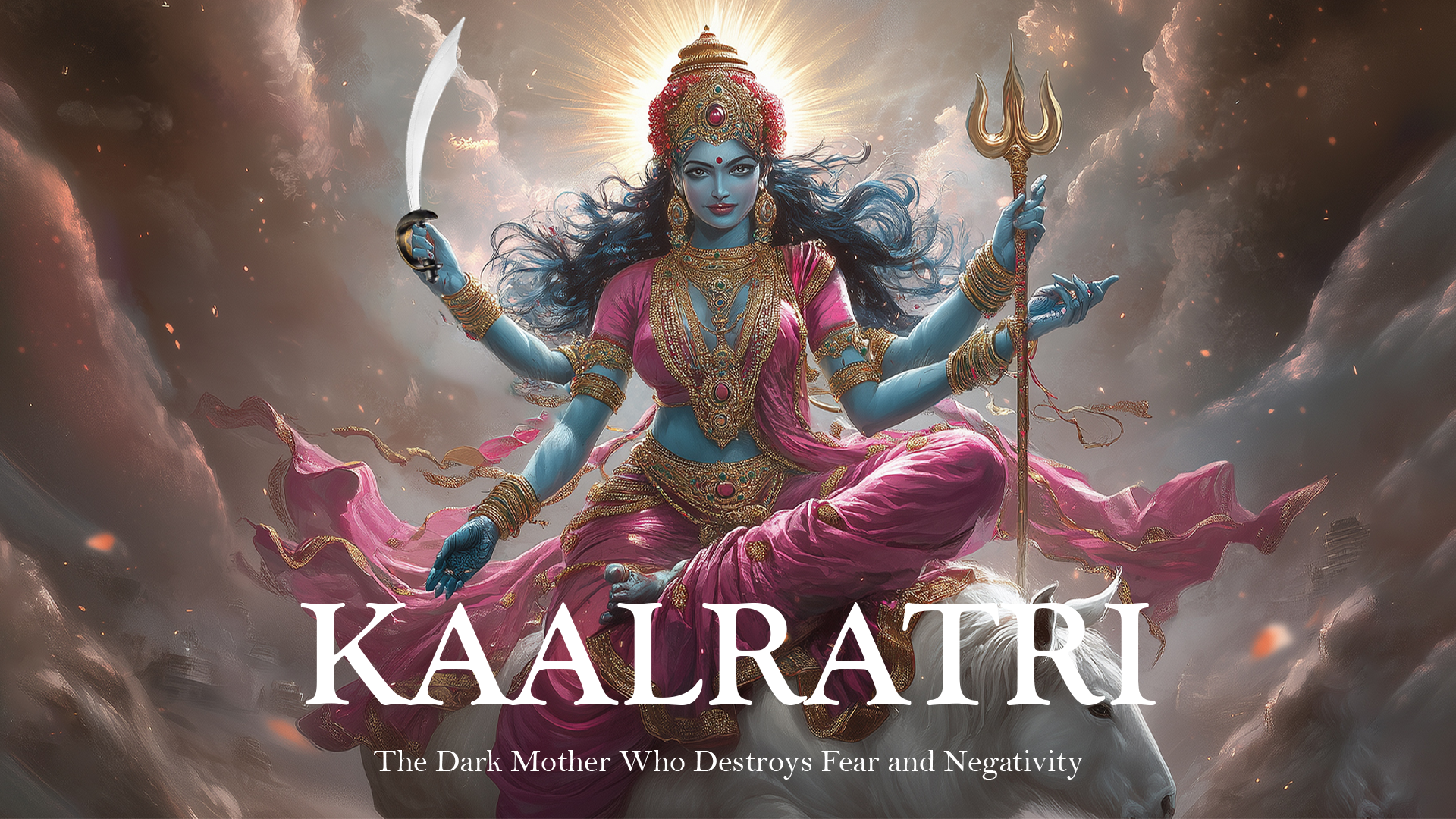
Kaalratri: The Dark Mother Who Destroys Fear and Negativity
It is the seventh day of Navratri, and this night belongs to the Goddess Kaalratri, considered by many to be the fiercest of the Navadurgas. If the earlier forms of the Goddess were about light and growth, this form is of fire, shadow, and courage. You may have heard the saying “Hell hath no fury like a woman scorned.”. Kaalratri, or Kali, as many of us know her as, is that fury, unleashed on the battlefield.
When Heaven fell and Demons rose
The story starts when heaven was breached and conquered. The demon brothers Shumbha and Nishumbha had seized the throne of the gods, forcing even Indra into hiding. Their trump card was the fearsome Raktabija, a demon cursed, or blessed, depending on which side you were on, withe the ability to regenerate a version of himself with every drop of his blood that touched the ground. Imagine, the blood from one single wound could create an entire army. The battlefield grew crowded, filled by clones of Raktabija, and the gods were overwhelmed, and began to despair.
Shumbha and Nishumbha had two able generals, Chanda and Munda. To beat them, the Goddess took the form of Chandi, and stepped onto the battlefield, cutting down one enemy after another, until Raktabija entered the fray.
Enter: Kaalratri
Knowing this needed a change of strategy, Chandi manifested Kaalratri. She was black as midnight, hair unbound, eyes sparkling with lightning. She rode on a donkey, almost mocking the demons. With each step her mount took, the earth trembled.
Charging at Raktabija, she fought, and cut him down. Again, and again, and again. Countless clones popped up, until Kaalratri had an idea, to do what nobody else had dared. She drank Raktabija’s blood before it could hit the ground. She began cutting through the innumerable clones with relative ease, until the entire clone army vanished.
Her rage though did not end with this battle. Kaalratri’s fury was terrifying, and threated to destroy everything she laid her eyes on. It was only when Shiva himself lay beneath her feet that she paused, taken aback by her own violence, and only then, did the storm go away.
Kaalratri as the Destroyer of Fear, Ego, and Negativity
On the seventh day of Navratri, devotees worship Kaalratri. Her dark colour symbolizes the Muladhar Chakra of the Kundalini Life Energy. Her fierce form represents the awakening of this power. When this energy awakens, it rises to the Sahasrara chakra, or the crown chakra of the Kundalini Life Energy, symbolised by Shiva lying at her feet. Kaalratri’s calming represents the control and balance of this power.
She is also the force that clears away fear, ego, and negativity. Her story tells us that sometimes, gentleness is not enough. It is necessary to be fierce to protect things and people close to us.
Kaalratri’s Rage and Fury in Today’s World
This story may be centuries old, but it isn’t just a mythological story. It’s the tale of every woman who has been called “too much” for standing up for herself. Kaalratri represents the feminine rage women are often taught to swallow.
During India’s independence struggle, Kaalratri was also the symbol of revolution, of ‘Mother India’, calm, but ready to rise and fight for what was right.
Even today, Kali, or Kaalratri continues to be a symbol of revolution, not just in India, but also around the world.
Today, in a world that still looks down upon women for daring to raise their voices and stand for what they feel is right, what would happen if women stopped apologizing for their justified rage and started channeling it like Kaalratri did?
Perhaps, it is a point worth thinking about. Is real worship bowing before Kaalratri, or is it embodying her courage to say “Enough!”, when enough is truly enough.
0 Comments