
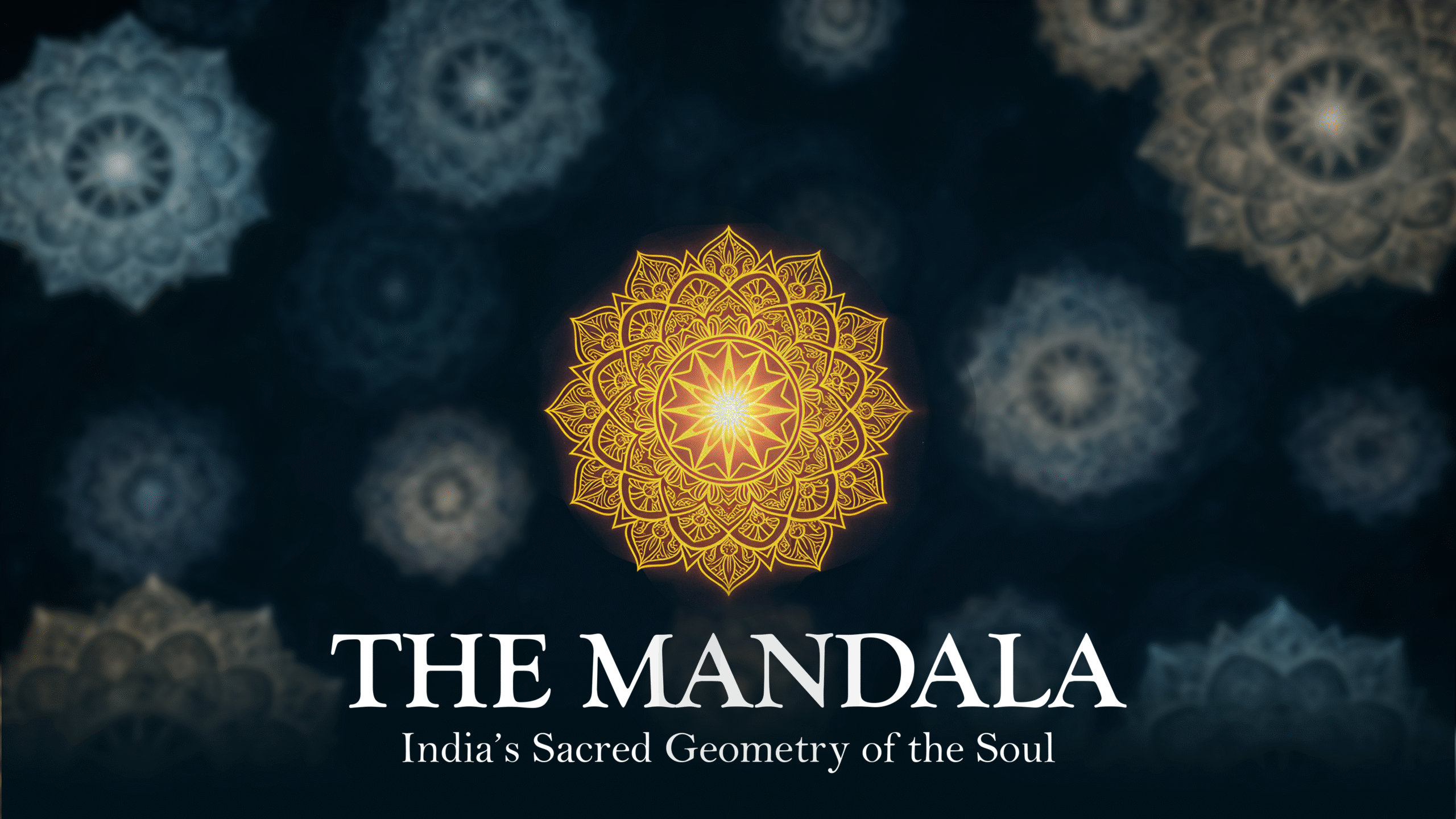
Mandala Art: The Cosmic Geometry of Indian Spirituality
Long before geometry had a name, the circle was already sacred. In India, that circle became the mandala, a symbol so simple, yet so vast, that it came to represent the universe itself.
The Origin of the Mandala: From a Dot to the Cosmos
The Sanskrit world mandala means “circle”, or “centre”. Every mandala starts from a single dot, called the bindu, which is the source of its creation, and expands outward into lines, petals, or other forms that reflect the order of the cosmos. This is a way to make sense of infinity through symmetry.
For centuries, monks, artists, and architects have used mandalas to focus the mind, still the breathing, and connect with something much larger than themselves.
Impermanence in Art: The Mandala That Disappears
In its earliest forms, a mandala wasn’t really permanent. It was drawn on temple floors with rice flour, coloured powder, or even sand. This would look beautiful for a day, but then, be gone with the wind.
In South India, some people still draw kolam mandalas regularly. In Tibet, monks spend weeks creating elaborate sand mandalas. All temporary, before they’re swept away by nature.
The idea behind the erasure of the mandalas is that nothing lasts forever. That impermanence itself is sacred.
The Architecture of the Cosmos: Mandalas in Indian Temples
Believe it or not, at the base of a mandala lies mathematics. Ancient Indian architects used mandala grids known as Vastu Purusha Mandalas to design temples. Every hall, corridor, and sanctum aligned with cosmic principles.
So, when you walk through a temple, you’re actually moving through a mandala, from the noisy outer world, towards the quiet, centred inner sanctum.
The Mandala’s Journey Across Civilisations
As Buddhism spread beyond India, the mandala travelled with it. In Nepal, it appeared in bronze and thangka paintings. In Tibet, it was believed to be a representation of the universe, laid flat on the ground. Moving over to Japan and China, the mandala turned into a symbol of balance and enlightenment.
And then, much later, the mandala crossed into the Western world, interestingly, through an extremely unlikely source.
Psychology.
Carl Jung and the Mandala of the Mind
In the early 20th century, Swiss psychoanalyst Carl Jung encountered the mandala while studying Eastern philosophies. He saw in its symmetry, something very profound. He said, this was the structure of the human mind itself, almost like an unconscious attempt by the psyche to restore balance.
Then, during his own period of emotional turmoil, Jung began drawing circular forms each morning. He noticed that whenever his inner world felt chaotic, his drawings became more fragmented, but as he regained clarity, his drawings grew more harmonious.
He came to believe that the mandala represented the Self, the whole of one’s being, conscious, and unconscious together. To draw or even contemplate a mandala, according to him, was to participate in the mind’s natural urge towards wholeness.
Through Jung’s work, the mandala re-entered modern life as a psychological tool; appearing in art therapy, dream analysis, and meditation. What Indian monks once used to map the cosmos, Jung used to map the soul.
From Temples to Therapy
Today, this practice has left the monastery and entered daily life. You’ll find it in meditation apps, murals, tattoos, and classrooms. Its meaning has stretched, but its pull remains the same.
People draw or colour them to calm anxiety, focus attention, or simply feel grounded. The symmetry does what words often can’t; it steadies the inner world.
Artists have reinterpreted it with paint, thread, metal, as well as pixels. Architects still use its proportions, consciously or not. And somewhere, a monk still brushes coloured powder into patterns, knowing perfectly that every stroke is only temporary.
Finding the Centre Within
Beyond design or ritual, this is a reminder of how the human mind works. Every experience we have goes outward from a centre. Be it our thought, choices, or emotions.
To live with awareness is to find that centre again and again, to draw the inner mandala each day; imperfect, changing, yet whole.
The Circle That Never Ends
Maybe that’s why the mandala never disappears. It’s not bound to a religion or culture; it speaks a universal language.
It reminds us that creation and dissolution are not opposites but part of the same rhythm. That what begins must end, and in that ending, begin again.
A circle has no corners, no edges, no start or finish. It holds everything, equally. And perhaps, its power lies in that simple truth.
So, as we observe the concept of existence without a beginning or an end, we must ponder this; Every ending folds into a beginning you cannot yet see.
Can you trust the circle to bring you back, even when the path feels lost?
Let us know in the comments below!
0 Comments