
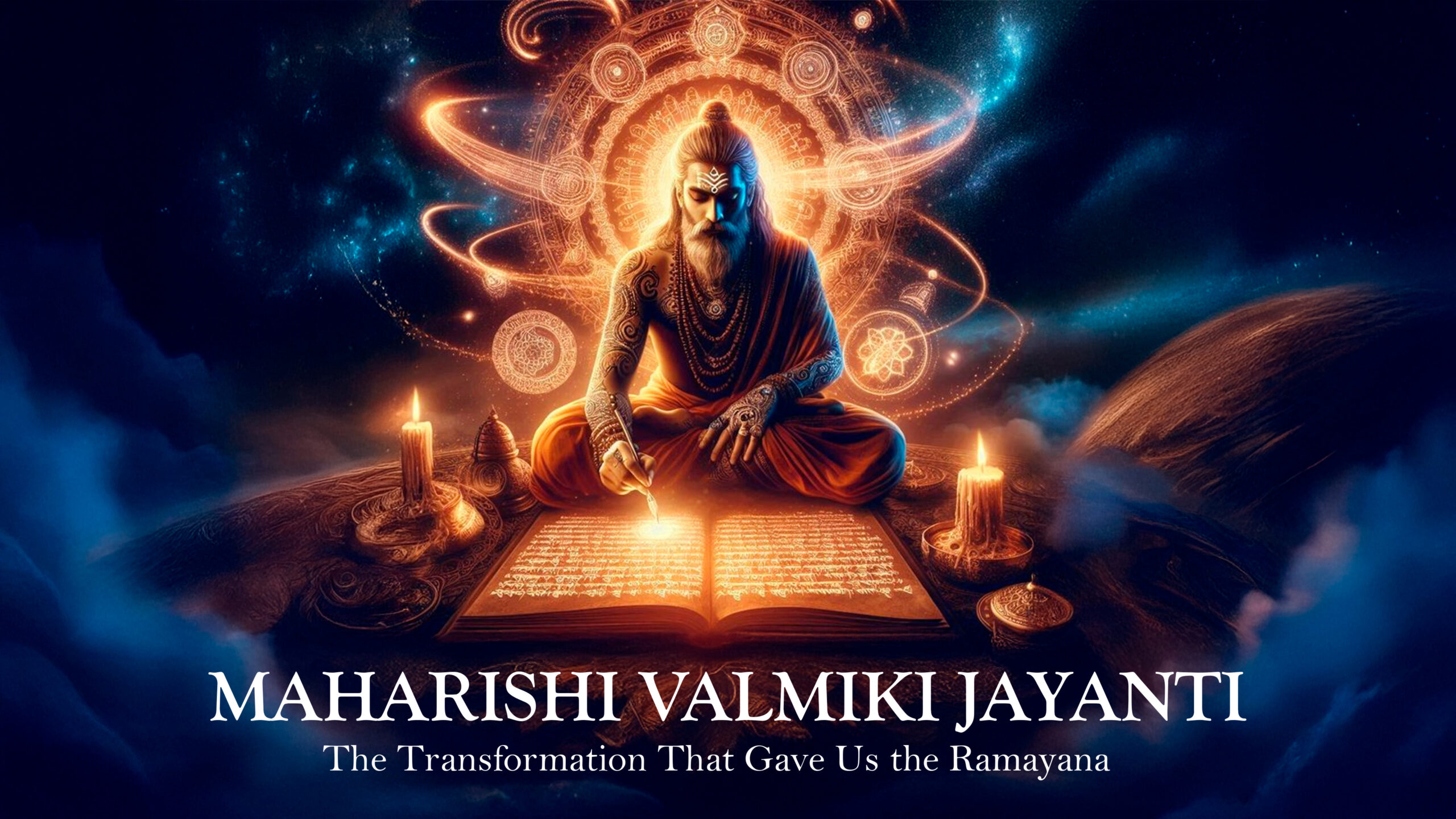
Maharishi Valmiki Jayanti: The Transformation That Gave Us the Ramayana
Where do you think history’s greatest writers are born? In libraries? In schools? But what if we told you that one of India’s greatest writers was a notorious thief named Lohajangha?
But who was Lohajangha really, and what did he write?
The eye-opener here is that Lohajangha, or Ratnakar, as he was also known, was none other than Valmiki, the man who wrote the Ramayana, and who is now respected with the title of ‘Maharishi’, and today, we celebrate Maharishi Valmiki Jayanti.
The Beginning – Before Lohajangha was Valmiki.
The story goes, Lohajangha’s life was a permanent hustle. He ran from pillar to post trying to have enough, just so that he would be able to feed his family.
One day, he came across a group of seven peaceful sages. He thought these men would be a nice, easy target.
Preparing to loot them, he confronts them, only to be asked one question – “If you’re doing this for your family, will they share the debt of your sins?”
The Moment That Changed Everything
That set him thinking. He walked home and asked his family. The answer left him shaken. A resounding “NO”. He realised, he was all alone, affected by the guilt of his actions. The loot he had gathered was not worth all this.
Lohajangha ran back to the place he met the sages, and asked them how he could make his life better. He was give a mantra, a chant of ‘Mara’, which means, to die.
From ‘Mara’ to ‘Rama’: The Chant That Rewrote His Destiny
So he sat and chanted. Days turned into weeks, and into years. He continued, not bothered by anything, not bothered that a colony of ants built an entire anthill around and on top of him.
The only thing you could hear was him chanting “Mara, Mara, Mara”, which go blurred by the speed of his chanting and turned into ‘Rama’. He was no longer Lohaganjha, or Ratnakar. In his devotion, he had become Valmiki, one born from an anthill.
The Birth of the First Shloka: How Pain Created Poetry
Now a sage, Valmiki once noticed a beautiful couple of Saras cranes playing with each other, when suddenly, a hunter’s arrow hit the male crane. The female, not believing her partner’s demise began to cry, as birds do.
Valmiki could not bear this. In grief and anger, he began to write the first couplet, the first Shloka of Sanskrit Literature. He would later, go on to write the Ramayana, and is still revered and respected by millions as the first writer of Ramayana, of Ram’s story, even with thousands of versions written by accomplished writers coming after the first edition.
The Message of Maharishi Valmiki Jayanti for Today’s World
Valmiki’s story isn’t ancient or old. It’s evergreen, and it is something we all can learn from. His story was the first instance of ‘Hard reset’ we come across. It is a story we’ve seen big personalities do often. Stop, think, and reinvent In today’s world, maybe that’s the whole message. The ‘Hard reset’ we seek is not digital. Rather, it is spiritual.
Valmiki’s story also reminds us that evolution isn’t about adding more to our lives, it’s about shedding what no longer serves us. His transformation was not born out of a dramatic act, it was out of one simple, honest question.
Maybe that’s what we need today, honesty, which leads us to examine the sound of our own conscience, because sometimes, life’s biggest resets don’t happen when life changes, they happen when we change.
If you could pause and press the reset button today on any one aspect of your life, forgetting the past to reinvent yourself, what would it be, and what would your first step towards it be?
0 Comments