
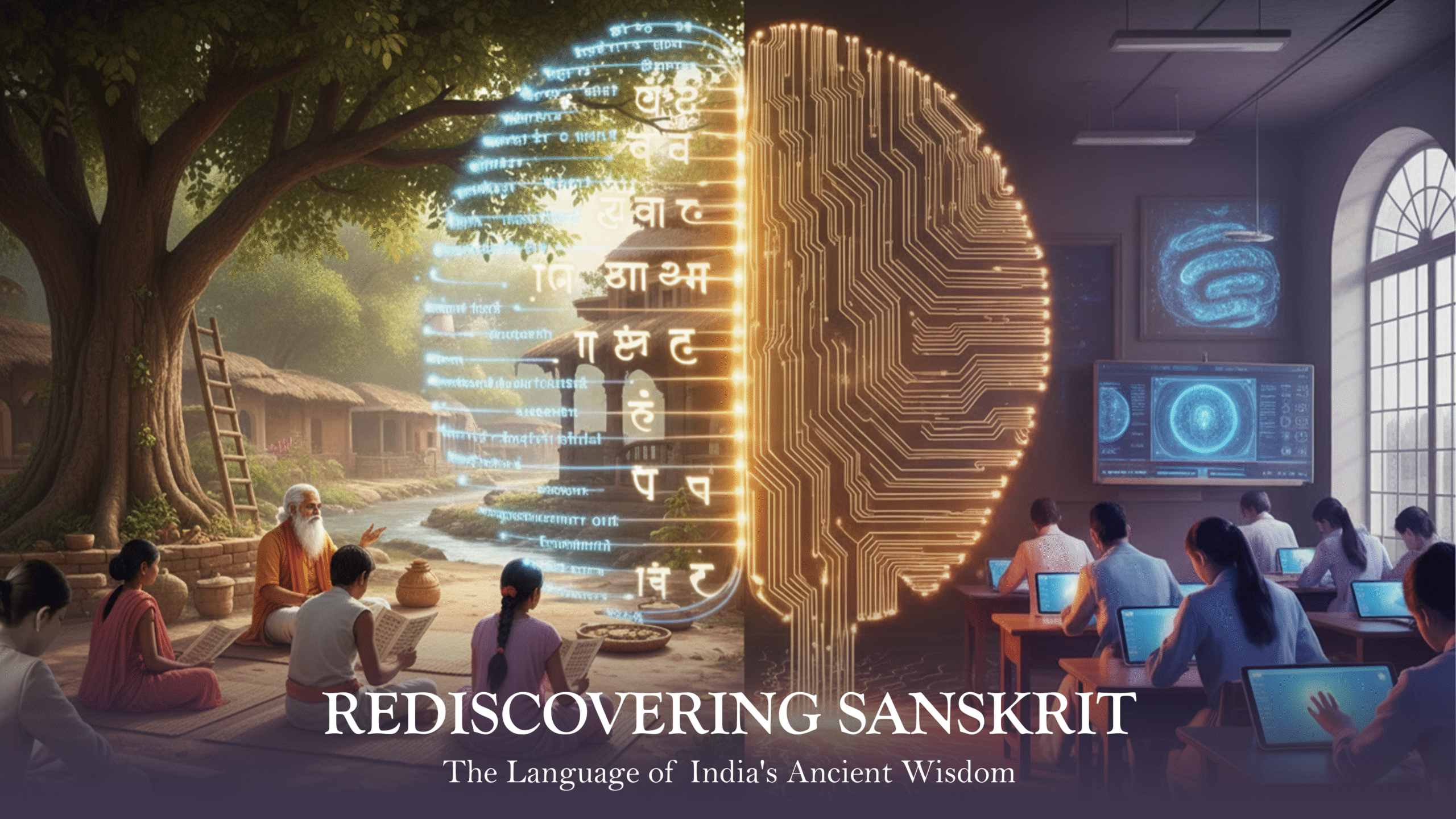
Rediscovering Sanskrit: The Language of India’s Ancient Wisdom
In recent years, there has been a remarkable resurgence of interest in Sanskrit, the ancient language of India. Universities are opening Sanskrit departments, young students are enrolling in courses, and scholars are publishing groundbreaking research on classical texts. But this renewed enthusiasm isn’t merely nostalgic reverence for the past. Rather, it represents a profound awakening to a vast reservoir of knowledge that was artificially silenced for over a century. To understand this movement, we must first examine what Sanskrit truly was and how it came to be dismissed as a “dead language.”
A Language of Extraordinary Richness
Sanskrit was far more than a ceremonial tongue reserved for rituals and prayers. It was a living, breathing language that captured the full spectrum of human knowledge and experience. Through Sanskrit, ancient Indian scholars made extraordinary contributions to mathematics, astronomy, medicine, philosophy, architecture, engineering, and governance. The language was the vehicle through which complex ideas about logic, linguistics, chemistry, and even aeronautics were systematized and transmitted. Sanskrit offered a comprehensive intellectual framework that addressed both the spiritual and material dimensions of civilization.
The name “Devvani”—the language of the gods—carried with it a paradox
Sanskrit isn’t just the mother of many Indian languages; it is a meticulously engineered system. Think of Pāṇini’s Aṣṭādhyāyī—a 4000-sutra grammar—as the world’s first formal, unambiguous programming language. Long before computer science, ancient Indian grammarians created a perfect model for thought and expression. While it elevated Sanskrit’s spiritual significance, it simultaneously created rigid barriers. The language became the exclusive domain of the privileged classes.
The Colonial Rupture: When a Living Language Became “Dead”
Until the late eighteenth century, Sanskrit remained the language of India’s intellectual and administrative elite. Scholars, poets, and thinkers continued to produce original works. Knowledge flowed through its channels—political treatises guided governance, architectural texts informed construction, economic principles shaped trade, and engineering knowledge advanced technological innovation. Then came the British colonial period and with it, a deliberate transformation of India’s educational landscape.
The introduction of the colonial education system marked a turning point. Suddenly, Sanskrit was declared a “dead language,” fit only for religious mantras and ritualistic shlokas. This wasn’t an organic linguistic evolution; it was an institutional erasure. The vast intellectual traditions encoded in Sanskrit—its political philosophy, economic theories, architectural wisdom, engineering principles, and scientific knowledge—were systematically removed from the educational mainstream. Indian students were taught that their ancestral language contained nothing of practical value for the modern world. A century of intellectual disconnection followed, during which Sanskrit knowledge remained locked away, largely untapped.
Rediscovering a Buried Treasure
When we speak of rediscovering Sanskrit today, we are indeed referring to this immense, largely untouched treasure of knowledge. It is the recovery of a complete intellectual system that was deliberately marginalized. It is the reclamation of political theories that could inform contemporary governance, economic principles that might offer alternative perspectives, architectural wisdom that influenced civilizations, and engineering solutions that preceded modern innovation by centuries.
The current surge in Sanskrit learning represents more than academic interest. It is an act of intellectual reclamation—a recognition that India’s ancient language holds keys to understanding sophisticated systems of thought that were abandoned not because they became irrelevant, but because they were deemed inconvenient to colonial and post-colonial power structures. By returning to Sanskrit, we are not merely reviving a language; we are retrieving centuries of accumulated wisdom that continues to resonate with contemporary relevance and human inquiry.
0 Comments