
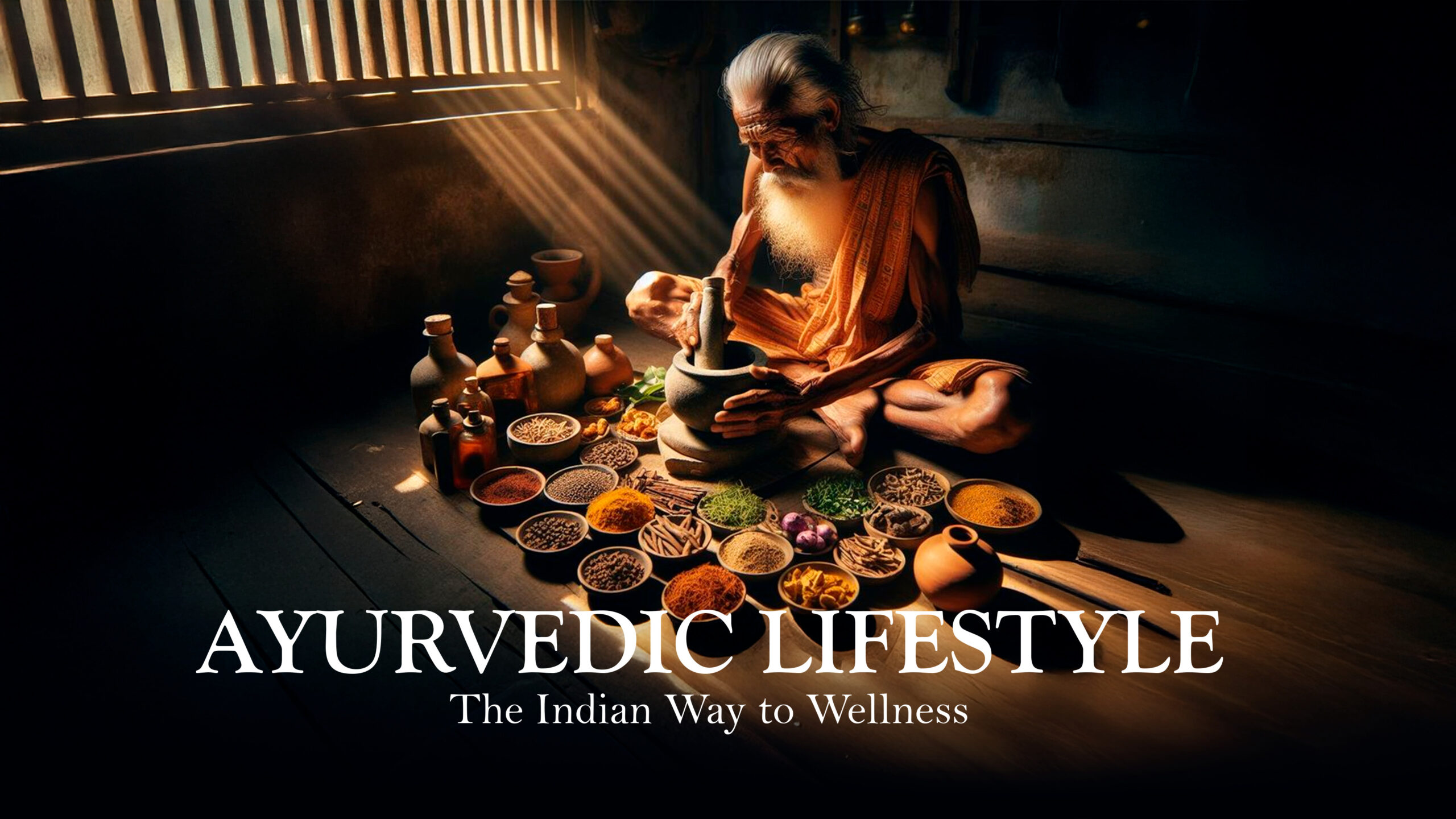
Ayurvedic Lifestyle: The Indian Way to Wellness
Picture this: The first light of dawn spills across the land, mist drifts above a still river, and somewhere, a temple bell hums softly, echoing through the silence. A man kneels by the water at the river bank and cups his hands to drink deeply, whispering something carried by the wind; A word that has now outlived empires.
Ayurveda.
What Ancient India Knew About Health
It’s a bit difficult to pinpoint when Ayurveda came to be, but the estimate is at about five thousand years ago. Interestingly, the sages back then didn’t study health as we do today, they observed, and heard the signals the body gave out, and also in the rustle of trees, the rhythm of rainfall, and the warmth of sunlight.
They believed that the universe spoke of health in patterns, and the human body was simply echoing it. They believed every heartbeat mirrored the pulse of the earth.
To them, health did not mean pills or cures. To them, it meant balance, a delicate alignment of the mind, body, and spirit, as well as the world around us.
They believed disease was a message from nature itself, warning them that they have gone off-balance. Ayurveda became their compass, their guide.
Ayurveda Lessons For A Modern Life
Today, thousands of years later, that compass is still a guide. We may live in cities that never sleep, staring into blue-lit screens, with our days fueled by caffeine and haunted by deadlines. But our bodies still remember what the world has more or less forgotten by now. They want rhythm, sunlight, even simplicity, which are essentially the same things our sages once wrote about under Banyan trees.
Let’s consider this; When we wake with the sun and let its first light touch our skin, we actually practice an ancient ritual that is now known as sunlight therapy. This is nature’s way of reminding us that warmth and clarity can only be found in the sun’s glow.
When we walk barefoot on grass, we reconnect with the earth. Today, that custom is called ‘grounding’, and this was something our ancestors did casually, without thinking
Our morning glass of water isn’t about simply hydration, it is purification, telling our body that it is being cared for. Eating, not for hunger, but for nourishment makes us return to one of Ayurveda’s basic teachings, that food is basically medicine.
Interestingly, even fasting, a practice that now trends on wellness blogs, was understood by our ancestors as a ‘hard reset’/ They knew that a detox and a reset would heal both the mind and the body.
Even when life threatens to overwhelm us, Ayurveda teaches us to align with our current situations, to breathe slower, to rest more, to sleep earlier, and to focus inward when the world gets too loud.
Ancient Wisdom For Modern Wellness
To say that Ayurveda is a whisper of a forgotten past is incorrect. Ayurveda practices are timeless. Consider Panchakarma, yoga, or even meditation. While they may sound complex, but the principle behind them is quite simple. They get us back to our body’s original settings.
Ayurveda is not about rejecting modernity. Instead, it’s about remembering our ancient wisdom and finding ways to implement it in our daily life.
For example, let’s try waking up to the sunlight seeping through our curtains, instead of a loud alarm. Let’s try treating breakfast as a tiny daily ritual instead of a rush, and our walk as a form of meditation instead of simply a commute.
We don’t need to live in the Himalayas or in some cave to live in harmony. We only need to pause and look at what our body already knows.
In a world that has focused on quick fixes and instant cures, Ayurveda actually asks for something that can almost be considered revolutionary; Prevention, balance, and listening to our bodies.
Maybe, that’s the most interesting thing to consider. A system born when the world was far younger than today still holds the answers to a planet gasping for breath.
Maybe the next revolutionary approach to health isn’t in a supplement, app, or even a trend. Perhaps, it is waiting for us in the light of the morning sun, in the rhythm of our heartbeats, and in the space between two breaths.
So, we should consider this point, ask ourselves; Is the secret to modern wellness new? Or is it just remembering something our ancestors gave us?
0 Comments