
Chhath Puja: Meaning, Rituals, and Spiritual Significance
When the World Waits for the Sun: The Essence of Chhath Puja
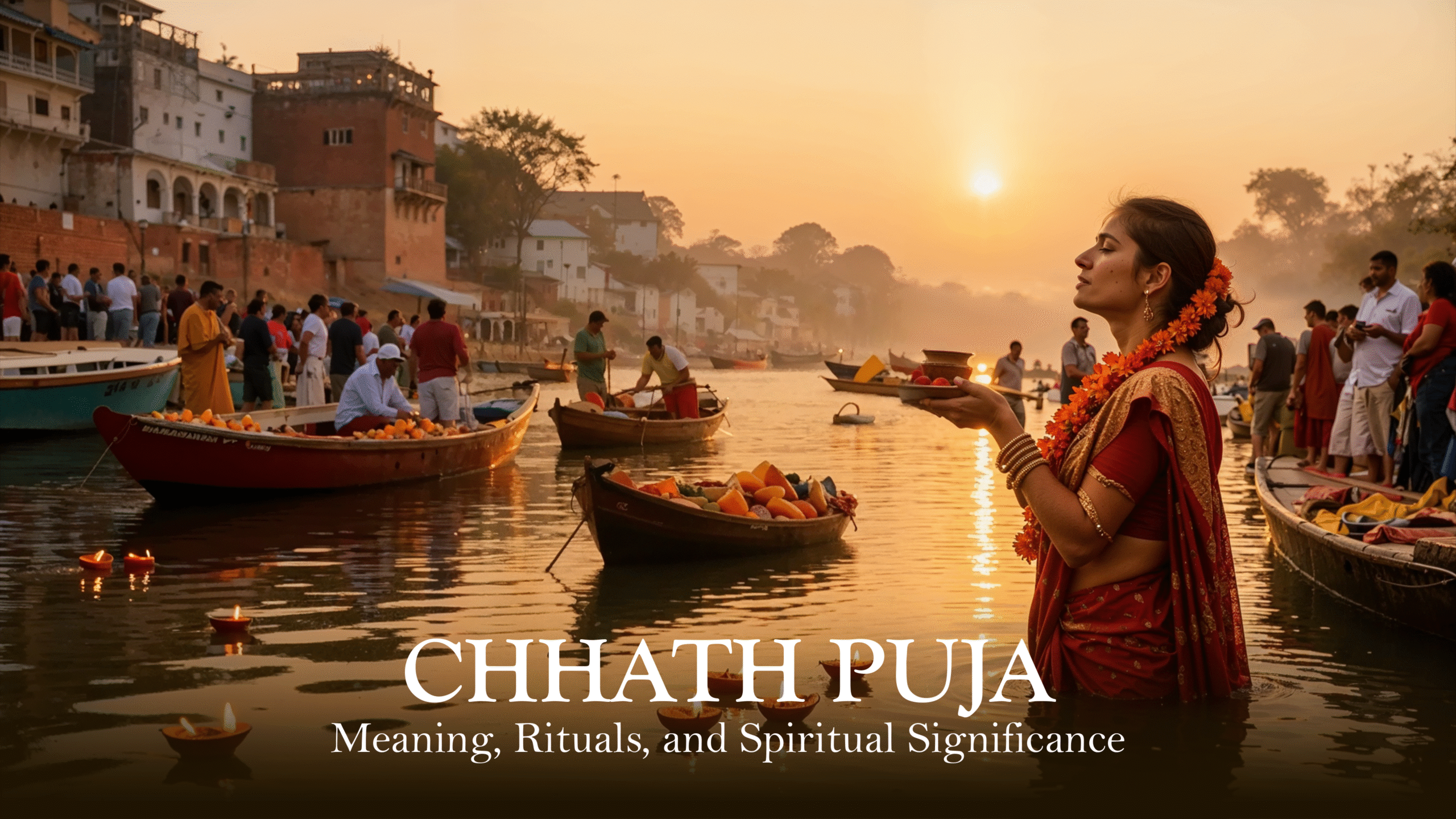
Imagine standing knee-deep in a water body before dawn. The world is silent except for the sound of the water. Across the horizon, the first light of the sun spills out like liquid gold, and hundreds of people join hands in prayer, to say thank you.
The people wait for the sun’s light, as well as its energy.
This is Chhath Puja, a festival dedicated to honouring the sun, as well as syncing the human will with its rhythm.
The Origins of Chhath Puja: India’s Oldest Practice of Focus and Discipline
A long time before productivity hacks and focus sprints became a thing, our ancestors had already designed theirs. However, this wasn’t packaged as self-improvement. This was a custom, a ritual that was as painful, as it was gratifying.
This festival of Chhath, celebrated primarily in Bihar, Jharkhand, and Nepal, is dedicated to the Sun God Surya, and his sister, Chhathi Maiya. Here, for four days straight, devotees undertake a regimen that would make anyone pause.
They undergo waterless fasts, sleepless nights, ritual purification with laser focus, and they do this for alignment, to align with their purpose, with nature, and themselves.
Stories Behind Chhath Puja: Ram, Kunti, and Draupadi’s Devotion to the Sun
As always, every custom has a story attached. In this case, we have three of them!
The first tells of the time when Ram and Sita returned to Ayodhya after exile. Legends say they performed what would become the first Chhath in the Sarayu river to celebrate the end of their exile, as well as to make an offering to Surya, asking him to not have them go through it again, asking for stability.
For, Ramrajya wasn’t built on charisma alone, Ram needed consistent, ethical discipline to forge his empire. After all, the old saying tells us, “Momentum wins you a battle, but discipline wins you peace”.
The second story takes us to the Mahabharat.
It is said that Kunti, while still a maiden, performed Chhath Puja to invoke the blessings of Surya, the Sun God. From that divine connection was born Karna, the radiant warrior who carried both the power and the loneliness of the sun within him. Chhath, in that sense, became more than worship; it became creation itself, the moment where faith and focus gave birth to potential.
Years later, when the world stood on the brink of war, Draupadi too turned to the Sun. In Nagdi village, Ranchi, she is believed to have performed Chhath Puja beside a spring, seeking Surya’s strength for the Pandavas’ victory at Kurukshetra. Even today, the villagers perform the ritual there by that same ancient spring, as if the ground still remembers her prayer.
Our third story takes us to the Puranas, where the Goddess Shashthi, which was another name for Chhathi Maiya, once restored life to a stillborn child, establishing a ritual for well-being and renewal.
The Four Stages of Chhath Puja
Now, Chhath Puja isn’t a random set of rituals. Rather, it’s a four stage execution model, designed for personal transformation.
- Nahay-Khaay – The Purge
The environment is cleansed; the devotee eats a single, simple meal of purity. - Kharna – The Focus
A single meal is followed by a 36-hour waterless fast. - Sandhya Arghya – The Offering
Offerings are made to the setting sun, a salute to completion. - Usha Arghya – The New Beginning
Offerings are made to the rising sun
Every year, this solar code is repeated by people to remind themselves that purity focus, gratitude, and renewal are spiritual virtues as well as performance metrics of the human spirit.
Chhath Puja and Modern Relevance: From Sun Worship to Self-Discipline
If you practice Yoga, you already practice sun-worship every time you do a Suryanamaskar. That’s your daily recharge.
Chhath, on the other hand, is your annual reset of discipline
In a world that spends all its time chasing comfort, Chhath tells you to drop those in search for your ultimate goal.
The best part, you don’t need to set off on a pilgrimage, or even perform the ritual the way it is, you need one self-imposed hardship aligned with one meaningful goal to learn the lesson Chhath tries to teach you.
For instance, if your goal is to write a book, your ‘Vrata’ might be a week without any social media with a mandatory 2,000 words before sunset, or, if your goal is fitness, it could be a sunrise workout streak, consistently, regardless of the weather.
That’s what Chhath tells us, discipline is the real fuel of success, not dopamine.
In that sense, Chhath is perhaps the prototype of modern resilience, the art of holding focus through fatigue, of choosing endurance over indulgence, of turning discipline into devotion.
The takeaway isn’t to fast or stand in a river.
It’s to find your own version of that river, the challenge that refines you, the discipline that reminds you who you are when comfort is gone.
So, when was the last time you deliberately made your life harder, not because you had to, but because you knew it would make you stronger?
Let us know in the comments below!
0 Comments