
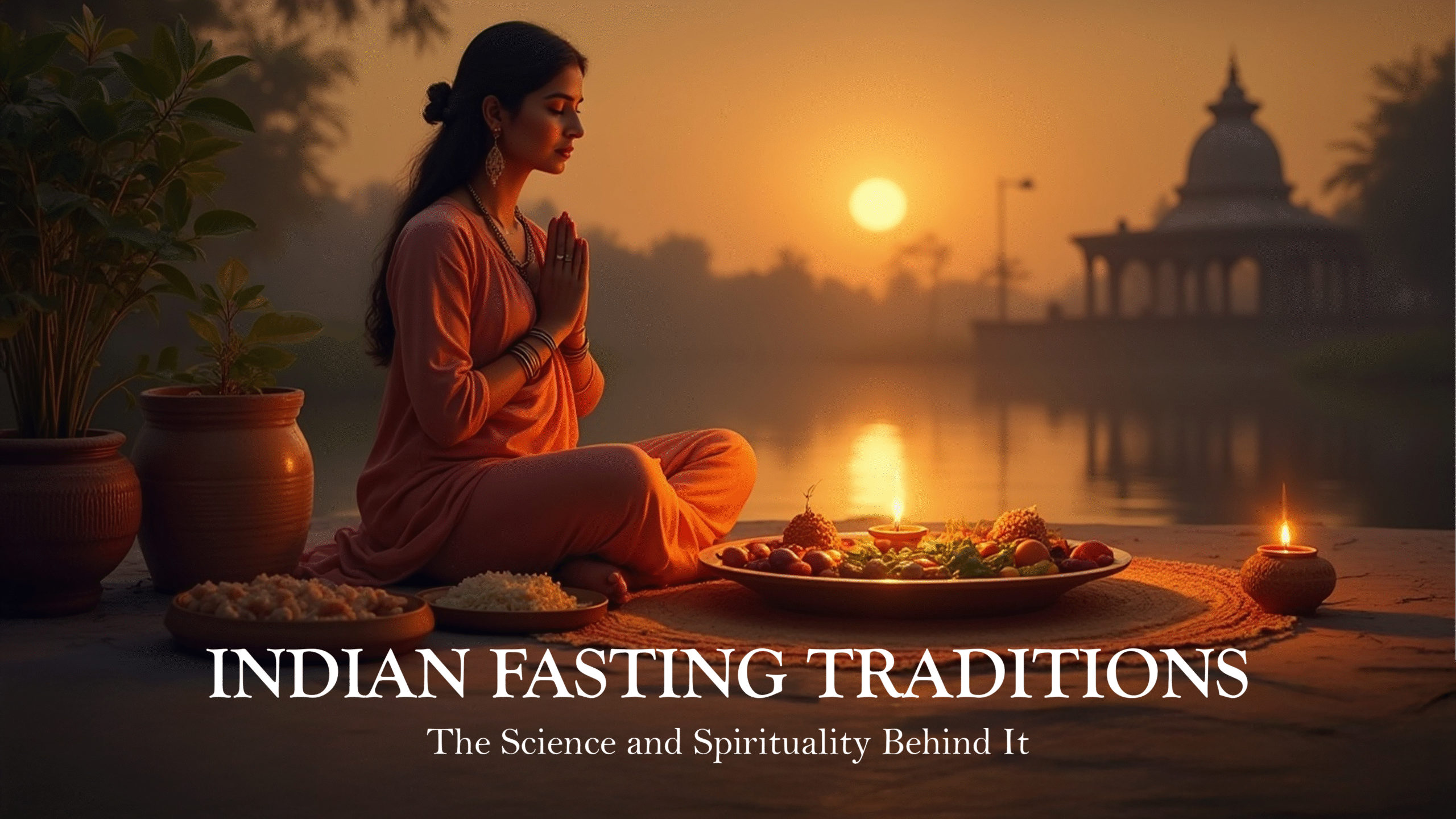
Indian Fasting Traditions: The Science and Spirituality Behind It
Stop! You’ve been lied to!
The secret to good health isn’t really what you eat. Instead, it’s in the moments when you choose not to.
Let us tell you a secret that’s hidden in plain sight. This is not about what you or your family cooks. Rather, it’s about the incredible, thousands-year-old rules they choose to follow when they don’t cook.
The secret, is the Indian concept of ‘Vrat’, or ‘Upvaas’, essentially a fast, but let’s put religious textbook definitions to the side. We’re talking about the map to a secret treasure that’s been passed down through generations, with the treasure being the roadmap to a more energized, more focused you.
The SOPs of fasting
Let’s imagine an ancient intellectual sitting by the river watching the world. As time passes, he realizes something, that our bodies aren’t machines, they’re supremely complex ecosystems, and when you constantly fill up the system, there isn’t a single moment left for a deep clean!
The intellectual must have noticed that digesting heavy food sucked up most of the body’s power. Almost like running a heavy background program on a slow computer, leaving no room for actual work.
So he must have drafted some SOPs back in the day, to periodically hit the pause button on consuming food.
While the above story comes from the writer’s imagination, this simple act of not eating probably didn’t start being about pleasing gods or deities. Instead, it was probably an act of hacking into your own biology.
Let’s consider it as the original detox for body and for mind. Now, you may have noticed how a smartphone works better after you restart it? Same principle! Fasting is like a spiritual and physical reboot, a chance for the body to focus its energy on other things instead of just digestion.
Swapping Food for a Fast
Now here’s where it gets fun (and perhaps, slightly complicated). When you fast according to the principles of Indian culture, you don’t entirely stop eating. Alright, some do, but most switch to a highly restricted menu.
Out goes bread and rice, and in come the strange, tiny spheres of ‘Sabudana’, or tapioca pearls, fruits, and vegetables among other items. These foods were easy to digest, but rich in nutrients.
This is where the adventure gets specific. When you follow the Indian fasting code, you don’t just stop eating entirely (though some do). Often, you switch to a highly restricted menu—the ‘sacred fuel.’
When Fasting Turns Into Philosophy
Also, this isn’t a way to count calories. This is an exercise in mindful attention.
As you fast, you begin to notice you aren’t bogged down by a heavy meal. Your mind can finally tune into things that really matter. Reflection, and community being the most important This is the very reason people like Mahatma Gandhi used fasting as spiritual purification, as well as a supremely powerful tool for political clarity.
The True Fast Is In The Mind
While you may not plan to go on hunger strike, or seek a specific deity’s blessing, but what fasting gives you can be extremely relevant in today’s age of constant consumption. The consumption may be food, news, anything at all. Fasting enters the scene as an act of refusal.
The beauty here is we find the concept of fasting in several faiths and cultures. Whether it is the month of ‘Shravan’ for Hindus, or even the month of ‘Ramadan’ for Muslims. The message remains the same
Maybe, just maybe, this is the point. We spend so much of our lives trying to fill up every space with food, noise, work, or even words. Perhaps we don’t notice that maybe the real power is in the empty space between things, and fasting, in its truest form teaches us that we shouldn’t fear the emptiness, that we should embrace it, because that is where we meet our inner self, without distraction.
So, what could you discover if you stopped filling up every moment of your life?
0 Comments