
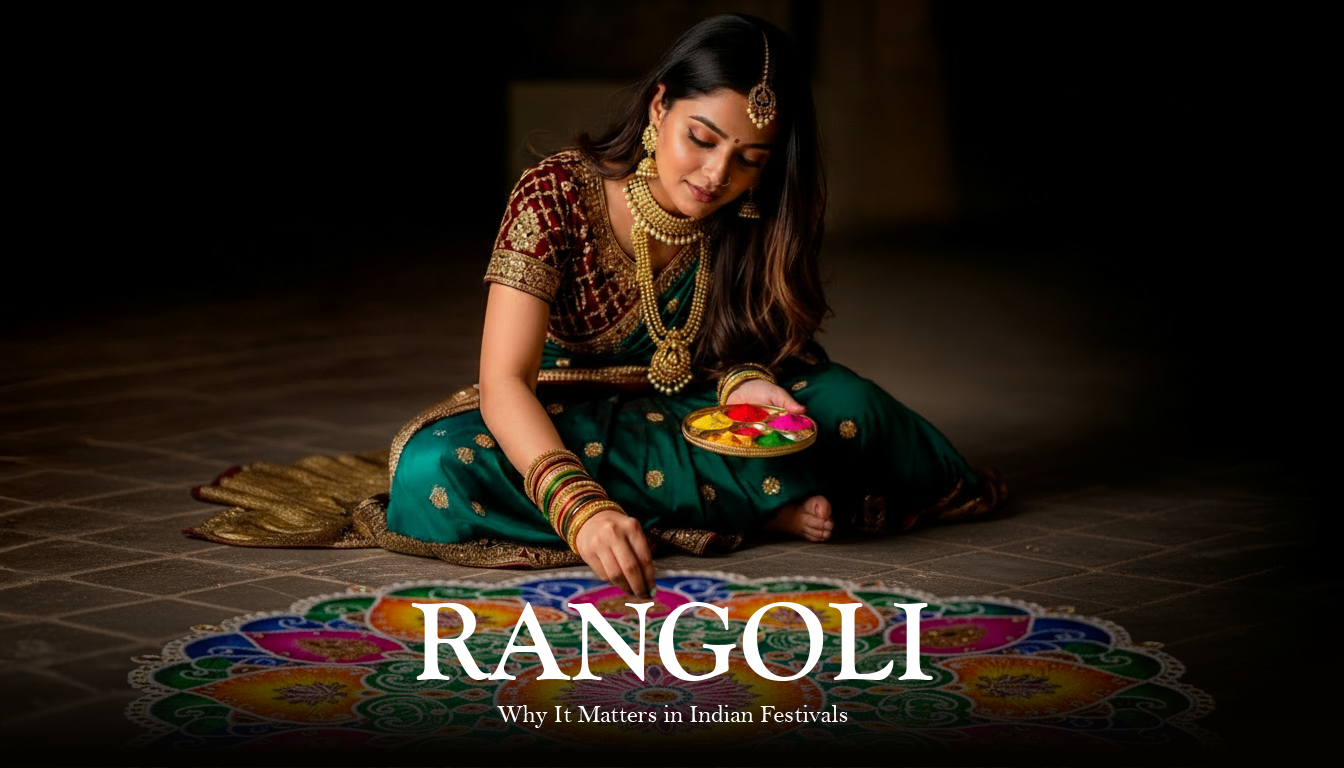
Rangoli: Why It Matters in Indian Festivals
We live in a world that keeps rushing on like a high-speed train, but every year, as the festive season approaches, millions of us Indians take some time out to get down on our knees and pour coloured powder onto the floor of our houses. We call it Rangoli, or Kolam, or Alpana, according to the region we’re from, but the essence stays the same. Decoration, but not just that.
Today, we have generations battling anxiety, digital fatigue, and severe pressure to perform. For them, the tradition of Rangoli can turn out to be an unconventional, but powerful antidote, almost like an ancient prescription to deal with modern chaos.
The First Whispers of Rangoli
Many argue that the word Rangoli is a blend of two words; ‘Rang’, meaning colour, and ‘Avalli’, meaning rows or creepers.
Our ancient texts also mention a story of King Nagnajit, who was advised to paint a portrait of a recently deceased young boy on the ground by Brahma, so he could be brought back to life. This act was of both divine creation, and focused devotion.
Think of Rangoli as a sacred welcoming mat. It is usually drawn near the entrance of a home, to invite two main entities.
The first, being the Goddess Lakshmi, the goddess of wealth, prosperity, and auspiciousness. The colours and the patterns are believed to be the preferred pathway for her to enter and then bless the household.
The second, being guests, or the Atithi. In Indian culture, we have an age-old saying; Atithi Devo Bhavah, which can be translated to ‘The guest is God’, and what can be a more colourful expression of hospitality, a promise that the home it decorates is a place of harmony, happiness, and peace, than a Rangoli?
Rangoli Beyond Decoration
The question we come across often though, is why does the tradition of Rangoli hold such importance for us today? Well, as the old saying goes, the goal is the journey, not the destination, and that applies here too.
The answer lies in the process, the finished picture is simply a beautiful add-on.
You may also see a Mandala in a Rangoli. A sacred diagram that represents the cosmos, the universe, and the nature of time. Drawing a Rangoli requires absolute focus. You cannot rush it, you cannot lose concentration.
The smallest shake of your hand or a moment of distraction will ruin the symmetry.
For today’s youth that is constantly multitasking, this is a lesson in single-pointed focus, or ‘Ekaagrata’. Think of it as a mindfulness exercise. For the time you spend making a Rangoli, your phone is down, your thoughts are silent, and the entire universe shrinks down the the flow of colourful powder you hold in your hand.
This is a meditative state that will ground your energy and calm the nervous system.
Interestingly, the most important lesson of Rangoli is that it is not permanent. It could be drawn beautifully in the morning, and swept away by the wind, stepped on, or even washed away by the evening.
Why We Still Need Rangoli Today
The idea of Rangoli is to pour our heart and soul into creating it, celebrate its temporary perfection, and the practice the art of detachment. The happiness and joy is actually in the making of a Rangoli, and its eventual fading away reminds us that the only thing permanent in life is change.
So here’s the lesson it teaches us; Don’t get attached to the outcome, instead, cherish the effort you make.
Drawing a Rangoli is a reminder that even in our concrete jungles, we could find a few square feet to create beauty, practice focus, and embrace the gentle wisdom of letting go.
When you look at a Rangoli, which part is more satisfying: the final beautiful image, or the calm, focused process of creating it? How can you bring that same single-minded focus to one of your big goals this week?
0 Comments