
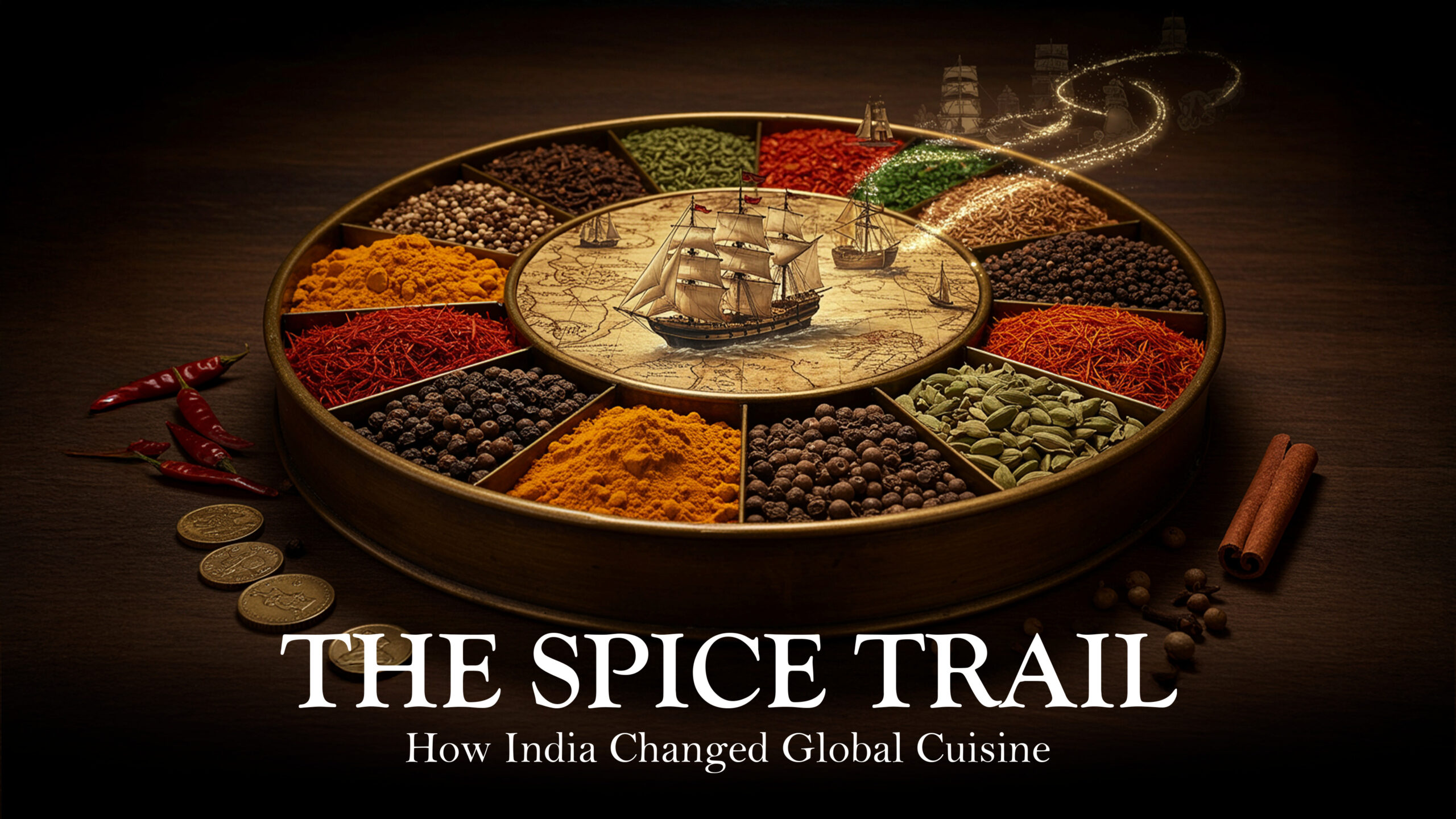
The Spice Trail: How India Changed Global Cuisine
The Invisible Power of Tiny Spices
It is almost comical how small they are. A peppercorn. A clove. A thin strand of saffron, or even a pinch of cinnamon dust
They’re tiny, weightless, almost forgettable, and yet, these little things once controlled the whole world!
Nations chased them, explorers gambled their lives for them, maps were redrawn because of them, people even killed for them! Empires also rose from them.
This was a chapter in human history when the world fought for more than just land. This was when the world fought for flavour.
And inside this global thriller sat India, quietly holding the master key.
Spices: Ordinary Today, But Once Worth More than Silver & Gold
Today these spices look ordinary. They sit in supermarket aisles next to ketchup and instant noodles. They are cheap, accessible, boring even.
But food without spices is almost like flavour without any soul.
Don’t believe the statement? Just imagine Italian pasta without pepper. Imagine a cinnamon roll, but without cinnamon. No chilli oil on ramen, no ‘masala’ in your daily cup of chai.
The fact is, almost every cousine we think of as “traditional” only reached that stage because spice showed up.
And the original hardware store for flavour was India.
The Maritime Spice Route: The World’s First Global Food Network
We talk endlessly about the silk road, but do you know, the silk road is actually the younger sibling of a far older trade route?
The Maritime Spice Route was already active by about 3000 BCE, which is about two thousand years before the silk route was established.
Imagine, this spice route existed before colonisers, and even before nation-states. And long before all this, India’s spices were already sailing out of ports like Muziris and Calicut, turning the Indian Ocean into the first global food network
Secrets, Myths & the Obsessed Hunt For Indian Flavour
Funnily enough, Arabian traders gatekeeping India’s spice secrets would often invent some outlandish stories to protect the supply chain. At one point, they even told Europeans that a giant cinnamon bird existed whose nest was made of cinnamon. And that to harvest the cinnamon, they needed to feed the bird some heavy duty meat so its nest would collapse.
So, essentially, what we now face as “Whatsapp news” was prevalent back then too!
Meanwhile, the real distribution was simple. Monsoon winds, catamarans, boats with sailors moving cassia, cinnamon, cloves, nutmeg, black pepper, and what not long before Europe even had any idea about spice.
And then, the demand grew.
In Rome, pepper was also used as currency. The Greeks developed cooking recipes that used spices obtained in trading with Arabia. Egypt went one step forward and used them for embalming bodies!
But the question remained. Where were these spices coming from?
And because they were clueless about the origins, they paid through their nose. It was a seller’s market. For a brief moment in time, pepper was worth more than silver, and nutmeg was worth more than gold.
Hypothetically, at that point of time, you could even go and buy property with sacks of spices.
Finally, the Europeans had enough. They decided to find the source of these spices.
Reaching The Source of Spices
The Portuguese were the first to actually reach India, with Vasco Da Gama actually sailing around the Cape of Good Hope in South Africa to land in Calicut, now Kozhikode
He had come looking for spice.
This was the turning point of that era, because once the sea route to India was opened for them, Europe changed its entire foreign policy.
The Portuguese, the Dutch, and then the British would soon establish entire sea empires partly built on controlling cloves, nutmeg, cinnamon, and pepper fields.
The rumour was that dock workers in London would be paid their bonuses in cloves, and that aristocrats collected pepper like jewellery.
Funnily enough, the Goths, when they breached Rome, demanded 3000 pounds of pepper as tribute
Interestingly, this lead to the most poetic twist of all. You see, centuries later in the UK, a dish invented from Indian spice logic, and Indian cooking techniques became their national identity. Chicken Tikka Masala.
This was evidence that spice actually travelled and rewired tastes in nations that did not know what Indian flavour was.
The Masala Dabba & the Everyday Logic of Indian Kitchens
Now, while European powers fought to control spice lanes, Indian kitchens did not change their tone.
The masala dabba, a simple round metal box, sat next to the stove in almost every home.
And before seasonings became an industry standard, spice blends were household knowledge, passed down from one generation to another.
Elsewhere, the rest of the world saw spice as treasure, while it was routine for us.
The greatest difference between us and them back then was that Europeans chased spice as a treasure, something to display, while this was part of our identity.
It may be 2025, but the echoes of this fact still remain.
What coffee shops sell as “Pumpkin Spice Latte” is a fancy drink that is basically pumpkin juice with cinnamon, nutmeg and clove. Turmeric latte is just a repackaged Ayurveda remedy for a sore throat.
The fad of ginger shots for good digestion? Also comes from India, just rebranded and repackaged to sell as “Organic” things.
European capitalism took our spices, and a part of our identity, and marketed it as something only they could’ve come up with
Climate, Supply Chains & the New Spice Economy
Today, spices are grown in India, Indonesia, Madagascar, Vietnam, Sri Lanka, and many such places, all scaled up for global demand.
And yes, vanilla crops still crash if cyclones hit Madagascar, Saffron prices take a hit if Kashmir produces less. Food labs test spices that can detect even 1% adulteration.
The trade may be digital, global, and instant, but the vulnerabilities haven’t changed.
Climate, soil, rain, skill, and the supply chain honesty. Spice trade is still heavily dependent on these factors, and a spice can still hold an ecosystem hostage, just like it did 3000 years ago.
A Pinch of Spice Is a Pinch of History
So tomorrow, when someone casually adds pepper to pasta, or sprinkles cinnamon on French toast, or chooses biryani over pizza…
Are they just seasoning their plate?
Or are they participating in the longest-running culinary legacy on Earth, one pinch at a time?
Because these tiny specks are proof that India didn’t simply join global cuisine.
India built global cuisine.
And the next time a masala dabba opens, maybe the world isn’t just smelling spice.
Maybe it’s smelling history.
So, when your masala dabba opens tonight, maybe this is something to be pondered; Are these jars in our kitchens mere storage, or are they heirlooms of a legacy that once steered ships and changed nations?
0 Comments