
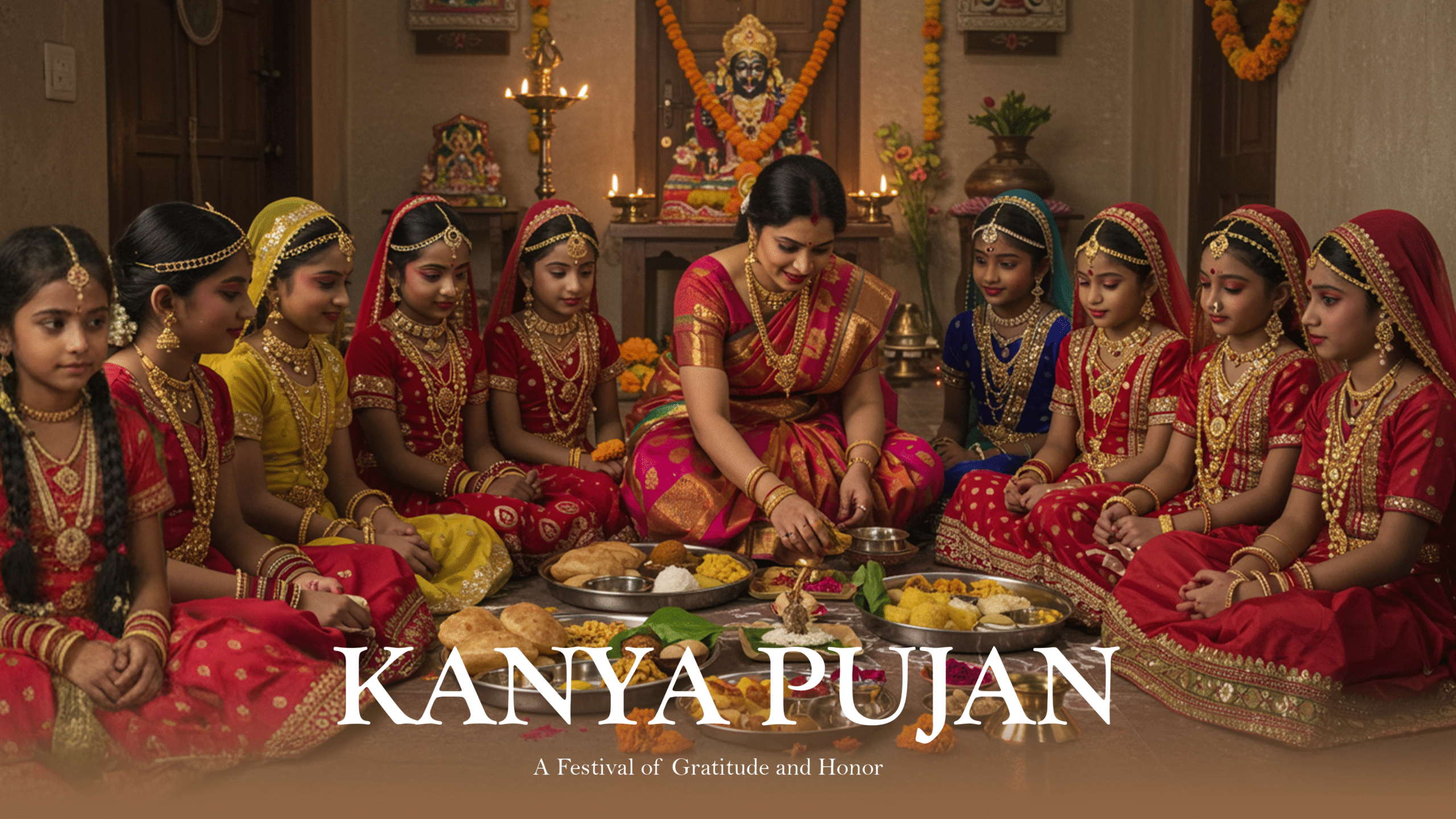
Kanya Pujan: A Festival of Gratitude and Honor
Navratri. The nine nights of the Goddess. We fast, we pray, we celebrate the divine feminine in all her forms—Durga, Lakshmi, Saraswati. But the culmination of this spiritual marathon, especially in North India, is an event that holds a profound, yet often overlooked, social significance: Kanya Pujan (or Kanjak).
It’s the beautiful practice of revering young, pre-pubescent girls as manifestations of the Goddess herself. We wash their feet, offer them a special meal (typically halwa, poori, and chana), and give them gifts or dakshina (money). On the surface, it’s a lovely custom. Dig deeper, and you unearth a powerful, timeless message that modern society desperately needs to heed.
The Mythology: An Ode to Shakti
Why little girls? Because in Hindu mythology, the Goddess Shakti—the primordial cosmic energy—is believed to reside in every female form. A young girl, pure and untouched by the complexities of the world, is seen as the perfect, unadulterated vessel of that divine energy.
This tradition isn’t just about charity; it’s about recognition. It’s an explicit, annual declaration that the female principle, even in its smallest, most vulnerable form, is worthy of worship and absolute respect. It’s a powerful cultural anchor that reminds us of the true status of women in the spiritual hierarchy.
The Modern Paradox: When Reverence Clashes with Reality
Here’s where the ancient wisdom of Kanya Pujan collides head-on with the grim realities of modern India. We celebrate the Kanya (girl) as a deity one day, yet statistics sadly reveal a chilling disrespect for her life and worth the other 364 days.
Think about the sheer cognitive dissonance:
- Female Infanticide/Foeticide: The practice of eliminating the girl child before or after birth—an atrocious crime that brutally rejects the very vessel we claim to worship.
- Discrimination in Nutrition and Education: The systemic biases where a girl is often denied equal access to food, healthcare, and schooling, stifling the very potential of the Goddess within her.
- Status in Society: Equal status in society is denied in a systematic way.
The ritual of Kanya Pujan thus transforms from a quaint tradition into a moral challenge. Are we genuinely worshipping the girl child, or are we simply going through the motions? The true spirit of this ritual demands that the respect shown during the ceremony must translate into actionable societal change.
Drawing a Parallel: Kanya Pujan is ‘Beti Bachao’ in Action
The government’s crucial ‘Beti Bachao, Beti Padhao’ (Save the Girl Child, Educate the Girl Child) movement is, in essence, a modern, policy-driven articulation of the Kanya Pujan philosophy.
- Beti Bachao (Save the Girl Child): Kanya Pujan teaches us to revere the girl child, placing her life on the highest pedestal—the altar of the Divine.
- Beti Padhao (Educate the Girl Child): By giving the girls gifts and money, the ritual subtly encourages their well-being and, by extension, their empowerment and education. A gift for a child is an investment in their future.
Kanya Pujan is our annual spiritual performance review. It asks us: Have you honored the Goddess in the little girl next door? Have you ensured her safety? Have you invested in her future? The dignity we bestow upon her in the puja must be the dignity we ensure for her in life.
The Great Wisdom
The enduring message of Kanya Pujan is simple yet revolutionary: Respect is not earned by age or achievement; it is inherent in the feminine form. This small ritual has the power to reshape the collective psyche, one meal, one foot-washing, one small act of worship at a time. Let’s make this day a pledge, not just a prasad. Let’s internalize the lesson: the girl child is not a burden; she is a blessing, a manifestation of the Divine Mother herself. Let’s empower her so that she can empower thousands more.
Reflective Question for You:
This year, as you participate in Kanya Pujan, ask yourself: “How will the respect I show this young Goddess today translate into a tangible action—big or small—to support the dignity and future of a girl child in my community for the rest of the year?”
0 Comments