
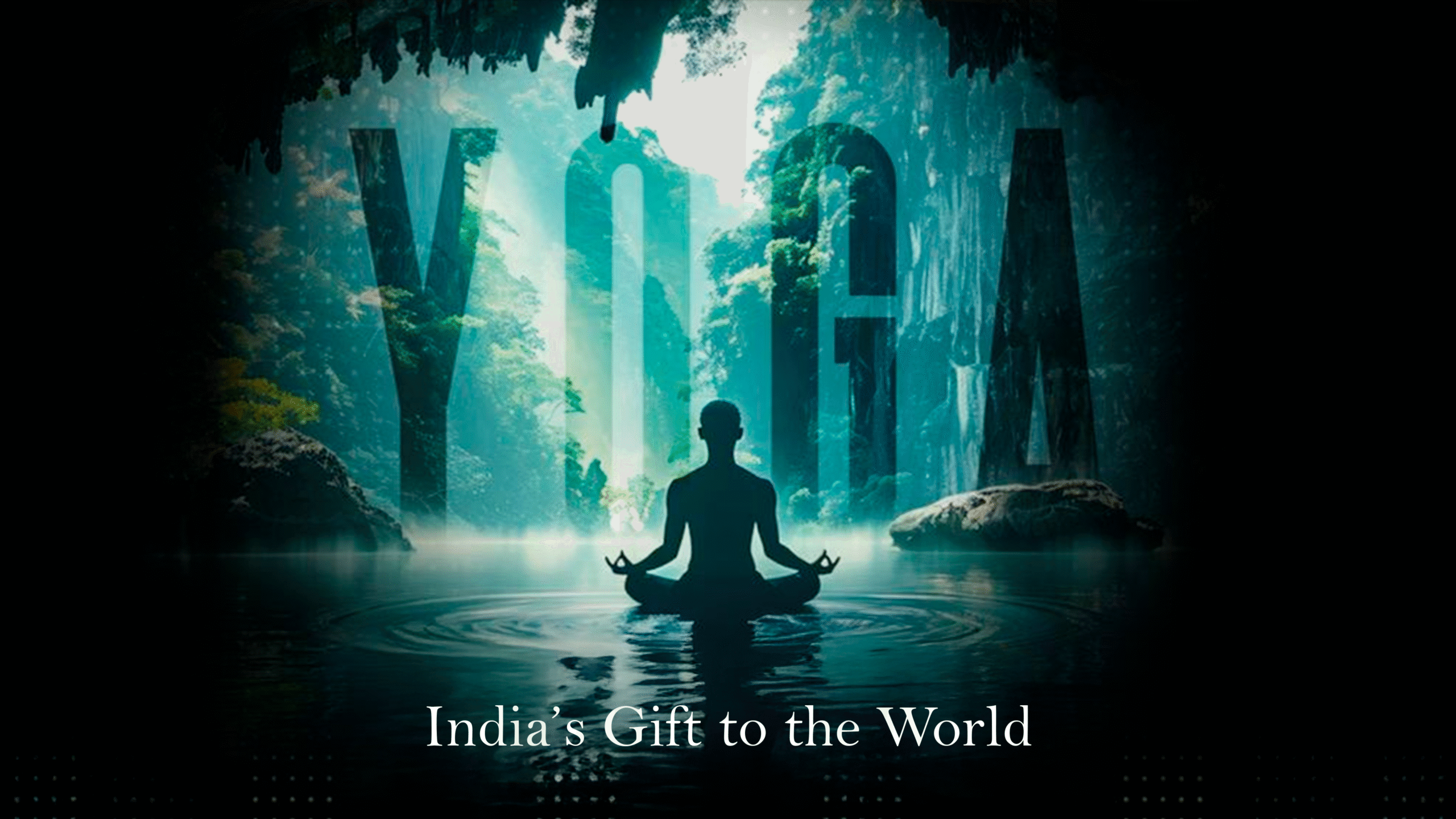
Yoga: India’s Gift to the World
Picture this: it’s 1883. A young Swami Vivekananda gets off a ship in the United States of America, armed with only wisdom. He speaks about culture and faith at a convention, getting applause and praise alike.
He then calls yoga a “science of the mind.” To a world that was, at the time, focused on machines and industrial progress, this was a spark of something different.
India became independent in 1947, and Yoga, at that point of time, was a cultural symbol, a reminder that the nation’s strength didn’t just lie in weapons, grand speeches, and promises, but also in its culture, its people, and of course, in the inner balance you got from Yoga.
Today, we have more than 36 million people practicing Yoga in the USA alone, and according to a study conducted by Zippia, that number crosses 300 million worldwide.
From Manhattan’s post penthouses, to the ashrams of Rishikesh, Yoga has become a universal language. A language of stretched bodies, calmed minds, and in some cases, of nirvana.
The West’s interest in our Yoga culture isn’t new. Back in 1968, The Beatles, the legendary British rock band decided that England wasn’t zen enough and flew straight to Rishikesh, to learn ‘Transcendental Meditation’. The media went wild, after all, it wasn’t every day that rock legends went to stay at an Ashram in a relatively un-explored part of India.
This visit made Westerners even more curious about Indian spirituality, and it also gave The Beatles some of their best songs, all while they tried to sit cross-legged without falling over.
Patanjali’s Contribution to Yoga
When you talk about Yoga, it is extremely important to remember one name that is usually forgotten in such conversations – Patanjali. He’s the person credited with writing the Yogasutras, a collection of tiny, powerful sayings that explain how the mind, body, and spirit work together. Alongside these, is a larger, detailed explanation called the Bhasya. Some scholars believe these works are as old as the Mauryan empire, some believe it to be written around 400 CE. The dates may be in question, but the essence of these works isn’t. Patanjali gave Yoga its backbone, turning it into a roadmap, not only for a better body, but also for a better mind.
The Many Faces of Yoga: From Hatha to Hot Yoga
The thing is, Yoga has never been about twisting yourself into the shape of a jalebi while your instructor, wearing tight clothes, spoke vague Sanskrit words. Its four pillars; Yama (moral discipline), Dharana (concentration), Dhyana (meditation), and Pranayama (breath control), have now been replaced by EMI options, early bird packages, “Organic Yoga Mats”, and of course, mandatory selfies after class in a fancy studio.
Hatha Yoga, what was once a humble path to balance, is now treated like the latest gadget launch. Balance today means going to the one-hour “Power Yoga” class that promises you an actor’s waistline and an athlete’s stamina, but only if only you buy the yearly subscription.
What was once practiced on riverbanks at sunrise, everyday, ritually, is now packaged in AC halls with mood lighting and peppermint-scented candles, all at the cost of a decent family thali.
Let’s not forget the variations! From hot Yoga in 45 degree celsius temperature (As if we needed more heat), to laughter Yoga that often ends with people crying at the bill. America alone spends about $16 billion dollars on mats, designer clothes, and even Yoga memberships that promise Nirvana in 21 days.
It may anger the purists, but perhaps, that’s the strength of Yoga. It stretches, it bends, it adapts.
Is Yoga Just Exercise or Something More?
Here’s the core message that the people of India, where the incredible wisdom of Yoga was actually born, must not let fade: You already hold the map to the treasure.
The West may have popularised the practice, which is wonderful, but protecting its philosophy is in India’s hands.
The whole point of Yoga is to remember that the sense of panic, the rush, the feeling of being constantly incomplete; that’s all the ego. The goal of every breath, every ethical choice, every moment of stillness, is to peel back those layers to reveal your true nature: a calm, boundless, and aware being.
Let’s consider this. You are a deep-sea diver in a clunky, old suit, walking along the ocean floor. You’re constantly bumping into things, running out of air, and you can only see a foot in front of you. That’s the small self. Yoga is the process of shedding that suit and realizing you were the vast, beautiful, all-encompassing ocean all along.
This may feel like ancient poetry, but it actually is a practical tool for daily living. In a world drowning in noise and distraction, the only Yoga that matters is the one that tells us to stop looking outside for what is already within us!
Practicing Yoga Today
Today, the world may buy Yoga as a workout. Focusing only on the pose, or the Aasan ignores the spiritual map laid out by Patanjali, which tells us that the goal is not a perfect body, the goal is actually a quiet mind. The true purpose of Yoga will always be a direct journey inward, which is shedding the ego to realise our unchanging Higher Self.
As we look at how Yoga is practiced throughout the world today, we must as ourselves this;
If Yoga’s original purpose, laid out by Patanjali, was a roadmap for a quiet mind, and not a perfect body, how does our current practice; whether it is Power Yoga, or a social media ready pose, actually serve that ultimate goal?
Do we use the Aasan, or the pose as a path, or have we turned it into the destination?
0 Comments