
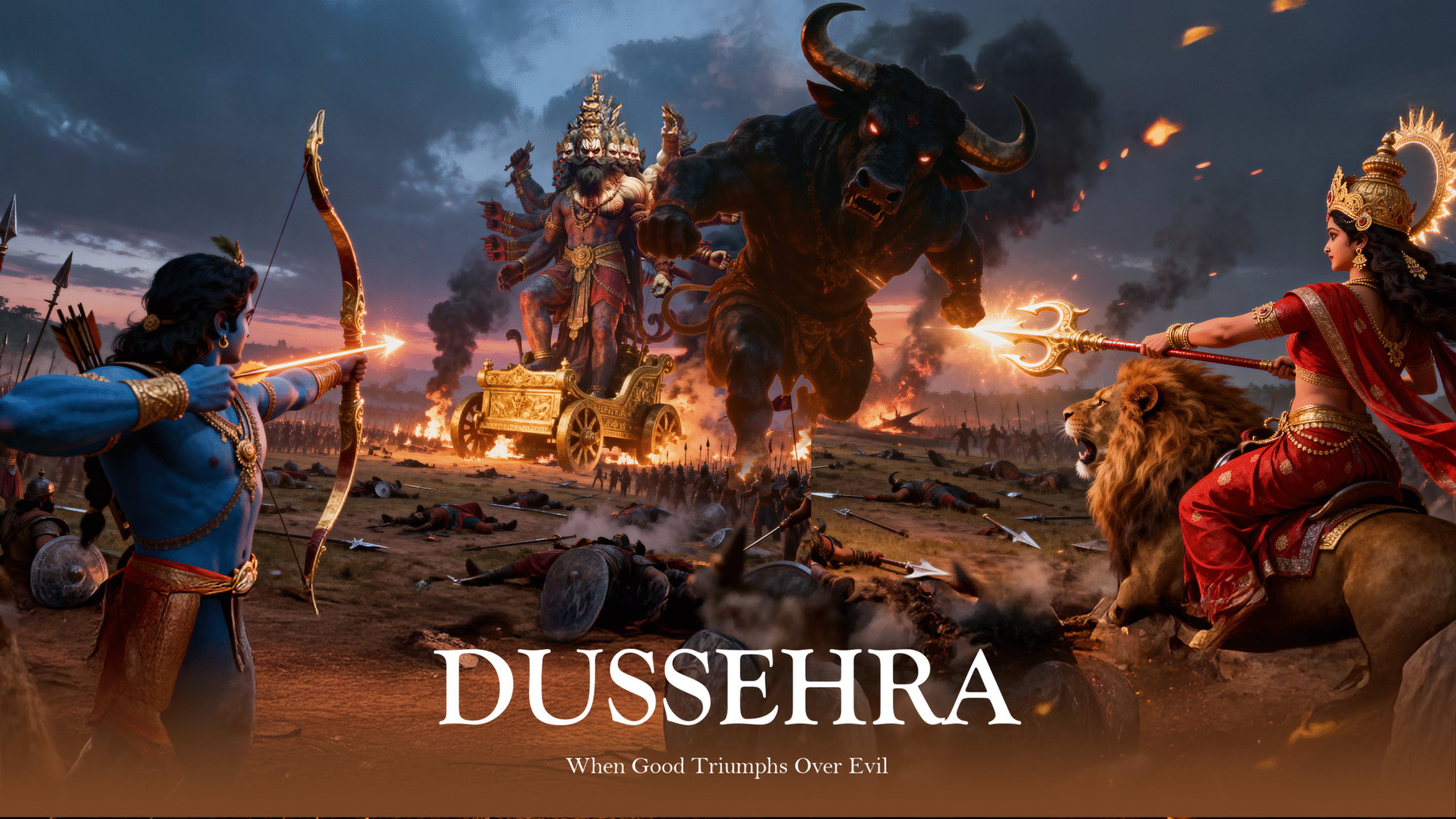
Dussehra: When Good Triumphs Over Evil
Dussehra, or Vijayadashami, is upon us—a time when we celebrate the resounding victory of Durga over Mahishasura, the mighty Asura King who was not ready to give due respect to women. He asked for the boon where only a woman can kill him. As he was thinking that a woman will never be able to rise to the occasion and will fight back.
There is also a big celebration that happens in Mysore. It’s called Mysore Dasara Utsav, where we experience the might of Indian kings in full glory.
But this day is also a reminder of a fight and ultimate triumph of sheer will of a person who literally left no stone unturned in search of his beloved wife. We are talking about Ram who stood against the formidable Ravana. We see the burning effigies as a triumph of good over evil, a simple, comforting narrative. But what if we peel back the layers of this ancient epic, the Ramayana, and see the battle of Lanka not just as a fight between a righteous prince and a demon king, but as a stark, powerful commentary on privilege, resources, and moral authority?
The King and the Exile: A Study in Contrasts
Look closely at the combatants. On one side, we have Ravana, the King of Lanka. He is the ultimate “have.” He rules over Lanka, the City of Gold, commands armies of powerful Rakshasas, and possesses unmatched magical and military prowess. His authority spans the three worlds (Tribhuvan). In modern terms, he’s the CEO of a global conglomerate, with unlimited wealth, power, and resources.
And then there is Ram. At the time of the battle, he is a literal “have-not.” He has been stripped of his kingdom, his title, and his rights, sent into exile in the Dandaka forest. He lives as an ascetic, with no royal army, no golden chariot, and no palace. His primary resources are his brother Lakshman, his wife Sita, and the loyalty of the Vanara Sena—an army of forest dwellers and tribal people often marginalized by the elite. Ram is a common man in the truest sense, fighting a war with borrowed resources and the sheer strength of his conviction.
The Moral Bankruptcy of Unlimited Power
The battle for Lanka, therefore, wasn’t a fair fight of equals; it was an extreme mismatch of resources. Yet, Ravana, despite his overwhelming advantage, was ultimately defeated. Why?
Because the foundation of his battle was rotten. He fought for an act of immoral desire and arrogant theft. He abused his power and resources to commit a wrong. He had all the physical means to win, but he was bankrupt on the only currency that matters in the long run: moral principle.
Ram, on the other hand, stood firm on a towering moral ground. His fight was not for a throne, but for Dharma—for justice, honor, and the principle of rightful conduct. He had nothing to lose but everything to gain in terms of honor. This unshakable moral center is what drew forces like Hanuman and Vibhishana to his side, people who chose principle over the comfort of privilege. It’s what gave his otherwise ill-equipped army the fierce determination to challenge an empire.
The Modern Dussehra Lesson
This Dussehra, as you think about conquering the “Ravana” within, consider this: What battle are you fighting today?
Are you fighting for a goal based on entitlement, arrogance, or shortcuts (the Ravana way)? Or are you fighting for a goal based on sincere effort, honesty, and principled action (the Ram way)?
In a world where success often feels dictated by who you know, what college you attended, or how much wealth you inherited, the Ramayana tells us an enduring truth: Resources can give you an advantage, but they cannot grant you victory. Only moral courage and unwavering integrity can do that. When your cause is right, your resolve can shatter the golden walls of any challenge.
Reflective Question: In a tough decision you’re facing right now, are you relying on the privilege you possess or the principles you believe in? Which will ultimately lead to a sustainable victory?
(Keywords: Dussehra, Vijayadashami, Ramayana, Ram vs Ravana, Privilege, Underdog, Moral Authority, Hindu Mythology, Youth Motivation, Dharma)
0 Comments